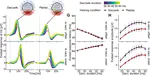
Every time we shift our gaze, our eyes make rapid movements called saccades. It is often believed that the brain pauses visual processing during these brief shifts, resetting only when the eye reaches its new target. Here, by comparing brain activity during natural eye movements with simulated motion replayed on a high-speed display, we demonstrate that the physical sweep of the eye itself actively drives early cortical responses. These findings show that eye movements are not blank gaps in visual perception. Instead, they represent highly structured sensory events that fundamentally shape how the human brain experiences and processes the natural world.