Visual consequences of saccades explain early cortical response dynamics during natural vision
Abstract
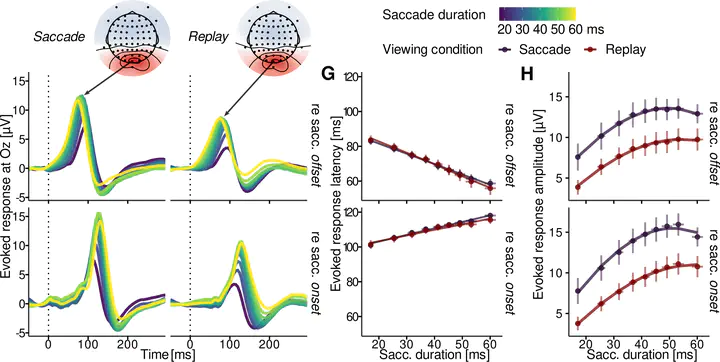
During natural vision, each saccadic eye movement evokes a large cortical potential known as the lambda response. Traditionally, lambda responses have been considered feedforward responses to new visual input arriving at fixation. In contrast, here we show that they are best explained by the retinal shifts induced by the saccade itself. We first recorded EEG data for thousands of saccades during free viewing of natural scenes and then replayed the same retinal image shifts on a high-speed display during fixation. Temporal response dynamics were virtually identical for real saccades and replayed motion, and most strongly aligned to saccadic peak velocity. A computational model based only on saccade trajectories, 1/f natural-scene statistics, and known human spatiotemporal sensitivity parsimoniously reproduced these dynamics. Our results show that saccade intervals should not be viewed as a gap in visual processing, but as a structured sensory event that shapes human cortical activity during natural viewing.
Every time we shift our gaze, our eyes make rapid movements called saccades. It is often believed that the brain pauses visual processing during these brief shifts, resetting only when the eye reaches its new target. Here, by comparing brain activity during natural eye movements with simulated motion replayed on a high-speed display, we demonstrate that the physical sweep of the eye itself actively drives early cortical responses. These findings show that eye movements are not blank gaps in visual perception. Instead, they represent highly structured sensory events that fundamentally shape how the human brain experiences and processes the natural world.

Richard Schweitzer
Vision Scientist
Passionate about psychophysics, eye tracking, M/EEG, computational modeling, and computer vision.